You know the task is waiting. You know it needs to get done. Then the reminder appears, you dismiss it, and somehow another hour passes.
Daily procrastination often does not require a complicated excuse. Sometimes, it only takes one ignored notification to start the cycle again. Mad AI: Angry Alarms approaches that problem differently, using deadlines, persistent alarms, photo proof, and an AI coach with a tough-love attitude.
This article looks at how Mad AI is designed to interrupt the familiar procrastination cycle and keep unfinished goals from quietly disappearing.
The Procrastination Cycle Starts With an Easy Escape
A task can remain unfinished when there is always an easy opportunity to deal with it later.
A reminder appears. It gets dismissed. The task stays on the list. Eventually, another reminder appears, and the same thing happens again. There is no additional step requiring the user to show that anything was actually completed.
Mad AI is designed around a different sequence. A goal begins with a specific task and a deadline. Reminders keep the task visible as the deadline approaches. Once the work is finished, the user can submit photo proof for an automated check.
Dismissal Is Not the Same as Completion
One of the central ideas behind Mad AI is that ignoring an alert does not mean the task has disappeared. The app uses reminders and escalating notifications to keep the pressure on before time runs out. Users can still stop a goal, but simply putting off the task does not turn it into a completed activity.
This is particularly relevant to everyday goals that are easy to postpone. Think about a workout that keeps getting pushed to later in the day. Or a study session that gets delayed because there is always something else to do. The same pattern can happen with household chores, posting tasks, and side projects.
Mad AI is built to keep the unfinished goal active instead of allowing it to quietly become another abandoned item on a to-do list. Its “Lock in or get annoyed” identity reflects that approach.
Procrastination Gets Harder When the Goal Needs Proof
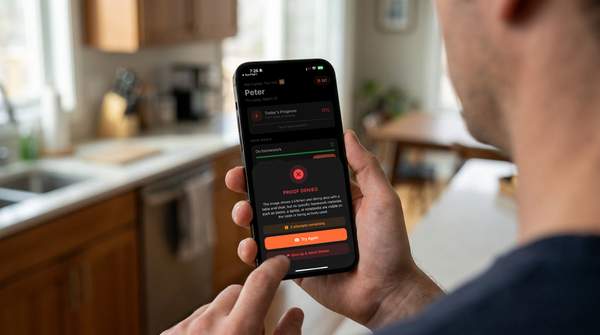
There is another way to postpone a task: mark it complete without really doing it. Mad AI addresses this by adding photo proof to the completion process. Instead of simply tapping a checkbox, users can upload a photo showing that the goal was completed. An automated check then compares the photo with the goal that was written.
That creates a more concrete endpoint for the task. If the goal is to complete a workout, the submitted image should relate to that activity. If the goal involves studying, the proof should correspond to the work. A household task can also be demonstrated through a visible result.
The system is not presented as perfect. Automated proof checks can be wrong, and users can retry with another photo. The point is not to create an infallible verification system. It is to make “done” require more than a single tap.
That extra step can make a difference for people whose procrastination extends to convincing themselves that they will get around to something later.
The Deadline Gives “Later” a Limit
“Later” becomes an easy destination when a task has no clear endpoint. Mad AI puts a deadline on the goal from the start. Users create the task, choose when it needs to be completed, and begin the countdown.
The deadline gives the reminders something to work toward. As time runs down, the task remains part of the accountability loop.
This is different from simply creating a long-term list of things to do. A goal in Mad AI is connected to a specific timeframe, which can make it more difficult to indefinitely postpone the same task.
The approach can work across different parts of a daily routine because the app does not limit goals to one category. Workouts, studying, chores, posting, and side projects can all fit the same basic system when completion can be shown through a photo.
The App's Personality Is Part of the Strategy
Mad AI would be a very different product if it delivered soft encouragement every time a user fell behind.
Instead, its AI coach uses tough-love copy, sarcasm, and aggressive reminders. The tone is deliberately direct. The app would rather annoy users into paying attention than quietly let an unfinished task fade into the background.
That personality can make the experience more memorable, but it also makes the intended audience clearer. Someone who wants gentle encouragement may not enjoy an app that keeps applying pressure. Someone who repeatedly ignores polite productivity reminders may appreciate having an accountability system that refuses to be particularly polite.
The important point is that the attitude is connected to the product's core function. The alarms, reminders, and coach all reinforce the same experience.
Mad AI is still a productivity app, not a therapy or medical tool. Its tough-love approach is focused on completing user-created goals.
Daily Goals Can Become a Visible Accountability Loop
The app's four-step process brings these ideas together:
- Set Your Goal: Create the task, define the deadline, and tell Mad AI what needs to happen.
- Beat the Timer: Work toward the deadline while reminders and escalating notifications keep the goal active.
- Upload Proof: Submit a photo when the task is complete so it can be checked against the goal.
- Keep Your Streak Alive: Build on completed goals and continue the cycle.
Mad AI Fits a Specific Kind of Procrastinator
Mad AI is designed for people who already know what they should be doing but have trouble following through.
That includes people who repeatedly dismiss reminders, students and adult learners who delay study work, people trying to establish workout habits, and anyone who prefers pressure over pep talks. It can also be used for chores, posting, and side projects that can be demonstrated visually.
Mad AI: Angry Alarms was created by Alessandro Sappia, who is based in Abu Dhabi, United Arab Emirates. The product has a clear identity built around accountability, deadlines, proof, and persistent reminders.
A Tougher Response to Everyday Procrastination
Mad AI does not approach procrastination by adding another quiet checklist to the day. Its system is built around keeping unfinished goals active.
A deadline limits how long “later” can last. Persistent alarms make dismissal less final. Photo proof adds a requirement beyond checking a box, while the AI coach brings a deliberately sarcastic and demanding personality to the experience.
That will not be the right productivity style for everyone. Some people prefer gentle reminders and flexible habit tracking. Mad AI is aimed at people who have tried those approaches and still find themselves putting things off. For those users, the appeal is straightforward. The app makes procrastination harder to ignore and gives completed goals a more tangible endpoint.
If you are tired of dismissing reminders and telling yourself you will start later, try Mad AI: Angry Alarms and see if a tougher accountability loop can help you finally lock in.