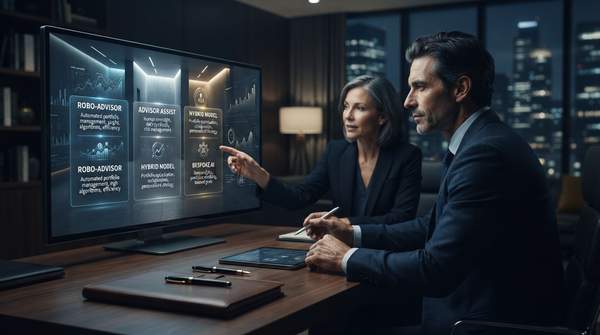
The "robo-advisor versus human advisor" framing is obsolete for wealthy investors. In practice, AI now enters wealth management through four distinct models: fully automated platforms, hybrid services that pair automation with human access, human advisors augmented by AI tools, and bespoke human-led advisory for the most intricate balance sheets. The right choice depends less on technology preference than on three questions: how complex your assets are, how much personalization you need, and how much of the process you are comfortable delegating to software.
For most high-net-worth individuals and family offices, the evidence points toward the middle of the spectrum. Automated platforms are built strictly for investment management using standardized inputs, and they struggle with the very things that define substantial wealth — private equity, business ownership, multi-generational transfers, and bespoke tax strategy. Below is a guide to each model and where the inflection points lie.
Beyond Robo vs. Human: Four Models of AI in Wealth Management
Industry observers increasingly describe the market as a spectrum rather than a binary choice. The World Economic Forum, writing in 2025, argued that the convergence of AI and human advisors is setting the stage for wealth management "through a seamless blend of human intuition and AI innovation," with institutions investing in the explainability of machine-driven recommendations while preserving personalized interactions. In that view, the near future belongs to collaborative models rather than replacement.
Advisory firms make a similar case from the practitioner side. Colorado Wealth Group describes a "third model" that the standard robo-versus-human debate overlooks: a fiduciary advisor equipped with native AI tools, which the firm says compresses analytical workflows and gives individual clients a level of deep insight previously reserved for elite family offices. Meanwhile, technology consultancies such as Itransition note that financial institutions deploy robo-advisors primarily to scale services to retail investors beyond the high-net-worth segment — a telling signal about where the fully automated model sits in the market's own architecture.